
Shaping a Succession of Classics — Master Yan Ka-man

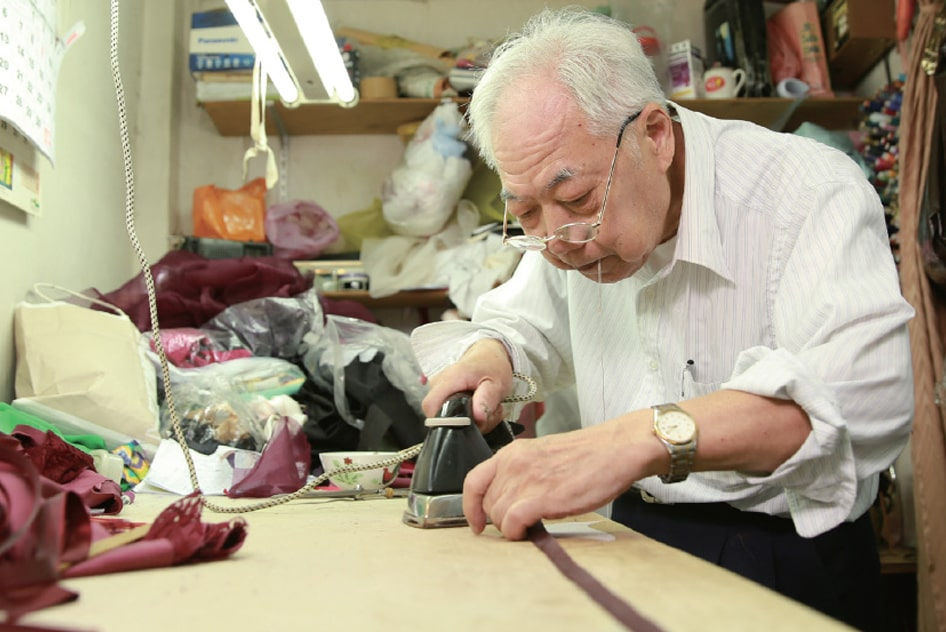
Master Yan Ka-man, now in his eighties, traces his ancestral roots to Jiangsu. Moving from Mainland China to Hong Kong in 1951, he embarked on the path of tailoring—a craft he has dedicated himself to for seventy long winters and summers. Rising from a young, green apprentice to an independent master tailor, he has spent his career shaping the history of Hong Kong entertainment, notably sewing costumes for Shaw Brothers Pictures and Television Broadcasts Limited (TVB).
When apprentices from the Jiangsu and Zhejiang regions first arrived in Hong Kong, they could not understand a single word of Cantonese. Their masters would require them to learn the local dialect as quickly as possible so they could be easily ordered to run errands. At that time, Master Yan was serving his apprenticeship at a shop on Prince Edward Road, and he was frequently dispatched to the vicinity of the Mong Kok Police Station to buy fabric piping (gun-tiao), as well as sewing threads and spools of various colors.
When it came to learning tailoring, Master Yan recalled that at the very beginning, the master would only teach the apprentices how to wear a thimble. He would then instruct them to practice needlework, such as using remnants of cloth to practice stitching fabric strips until they became proficient. Beyond these basic skills, any deep investigation into garment construction depended entirely on the apprentices observing the other tailors working in the shop. The tailor shop where he served his apprenticeship employed over a dozen tailors. In reality, the "master" referred to the shop owner, who did not make clothing themselves; instead, the owner went out to solicit business and returned to distribute the orders to different tailors. The shop accepted commissions for both men's and women's wear, and most tailors could draft and sew both. However, if someone excelled at menswear, those specific orders would be allocated entirely to him. Naturally, an apprentice had no choice in whether to learn menswear or womenswear first; they simply learned whatever they happened to observe. Yet, an apprentice's routine was incredibly frantic, leaving very little time to watch others work. Consequently, Master Yan jokingly remarked that even after three years of completing his apprenticeship, he still felt as though he had learned nothing at all.
Upon completing his apprenticeship, Master Yan was introduced by a relative to work in a tailor shop run by a fellow townsman from his native region. There, he became a "junior worker" (hou-sang), learning while he worked. Those working as junior workers were paid on a daily wage system, also known as "day-work" (zuo-gong), and the wage at the time was two dollars a day. The advantage of this arrangement was that it did not matter if he encountered a technique he did not know; he could simply inform the owner, and the task would be handed over to other skilled master tailors to handle on his behalf. Opposed to "day-work" was "piece-work" (zuo-jian), where wages were calculated based on the number of completed garments. Piece-work required a tailor to be fully capable of independently crafting an entire piece of clothing from start to finish, and their skills had to reach an exceptionally high standard.

Later, Master Yan moved to a shop on Tin Lok Lane in Wan Chai, owned by his maternal uncle, where he worked for seven or eight years. Subsequently, he worked in tailor shops on Bowring Street and Temple Street in Jordan alongside relatives. In his later years, the shop received many orders from Shaw Brothers International Film Company, mainly for women's clothing. For example, he crafted the Fengxian-collar costumes for Lily Ho in the movie The Five Avengers (1974), clothes for Ti Lung and Lisa Lu in The Empress Dowager (1975), and costumes used in King of Beggars (1992).
In addition, Master Yan made numerous garments for Michelle Yeoh and Lee Heung-kam. Besides Shaw Brothers, Master Yan also crafted costumes for many TVB drama series, such as The Duke of Mount Deer (1984) and Silver Spoon, Sterling Shackles (2012).
From his early apprenticeship to his career after completing his training, Master Yan’s journey was always intertwined with the care and introductions of his fellow townsmen.
Moreover, the Shanghainese tailors established a trade union to strengthen their connections. In 1949, the Shanghai Sewing Workers' Union was established, with its headquarters in Wan Chai. Master Yan also joined the union; only tailors from the Jiangsu and Zhejiang regions were eligible to apply for membership, which required a monthly fee. Master Yan noted that joining the union was not about fighting for specific labor rights, but simply about providing a supportive platform for fellow workers to gather and socialize.
Master Yan’s life became inextricably linked to the cheongsam (changshan), and his biography stands as a typical epitome of the many Shanghainese tailors who left their hometowns to seek a livelihood in Hong Kong. Bound closely together and supporting one another, they not only sewed one beautiful piece of clothing after another for people, but also steadfastly upheld this exquisite tailoring technique, making it a precious cultural treasure of Hong Kong today.


Comments