
The Historical Evolution of the Cheongsam: The Golden Age—1950s and 1960s


| The rise of women's status in the 1950s
In the 1950s, the Hong Kong government and all sectors of society worked together to revitalize the economy. The number of schools increased, improving educational opportunities for women and raising the overall level of education. Coupled with the post-war increase in job opportunities, women entered the workforce, gradually breaking down the traditional concept of "men working outside the home and women staying at home." As women entered the workforce, their purchasing power increased, their social circles expanded, and their demands for clothing naturally rose.
At that time, working women rarely chose to wear Western-style dresses. Even in work environments where Chinese and Westerners coexisted, women fluent in English preferred cheongsams, demonstrating their identification with their Chinese identity. They believed that cheongsams best accentuated their figure and classical charm. Cheongsams not only became a symbol of keeping up with the times, but also a dignified and appropriate outfit for going out and the mainstream work attire for white-collar workers, symbolizing women keeping pace with the times.
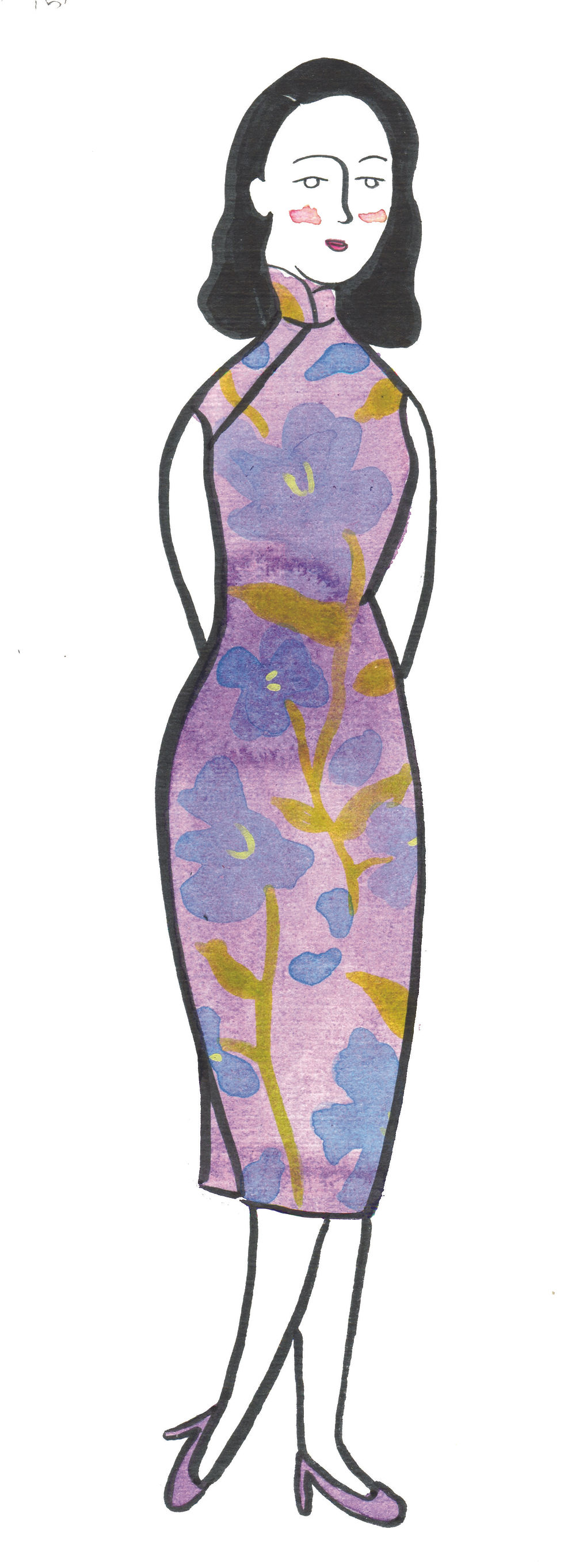
Hong Kong cheongsam: a fusion of East and West
In the early post-war period, Hong Kong suffered from a shortage of supplies, and many people still wore old clothes. It wasn't until the 1950s, with economic recovery and improved living standards, that Hong Kong cheongsams saw a significant breakthrough. Although Hong Kong cheongsams were influenced by Western fashion trends, until the late 1940s, they were still primarily flat-structured, rarely using Western three-dimensional tailoring techniques such as partial seams, set-in sleeves, and darts. They mainly relied on "gathering" techniques to make the garment fit snugly. Strictly speaking, most cheongsams at that time did not reach the level of "combining Chinese and Western tailoring." The biggest difference between pre-war and post-war cheongsams was the adoption of Western tailoring methods to create a three-dimensional structure, marking an important milestone in the development of Hong Kong cheongsams in the 1950s. Traditional flat tailoring is characterized by seamless seams, continuous front and back panels, and sleeves extending from the body, while Western three-dimensional tailoring simulates the human body's wearing posture, using "segmented" tailoring. Three-dimensional garments determine the structure of the clothing based on the human body shape. The key lies in the separation of the front and back, the diagonal cut, the set-in sleeves, and the "darts" at the waist of the front and back panels. Since the 1950s, Hong Kong cheongsams have fully adopted this tailoring method, combined with ironing and "gathering" techniques to make the cheongsams more form-fitting. As a result, the appearance of the cheongsam is very different from that of the past, presenting a characteristic of elegance with a touch of strength, and tradition with a sense of modernity.
Hong Kong Cheongsam Officially Debuts
In the mid-20th century, minimalism emerged in the West, influencing fields such as design, art, aesthetics, and thought. The minimalist style of Hong Kong cheongsams in the 1950s reflected the characteristics of the social environment at that time. Most families in Hong Kong at that time had just enough income to make ends meet, and even wealthy families practiced frugality. According to the 1956 Hong Kong Yearbook, there were still 31 secondhand clothing shops throughout Hong Kong, mainly located on Queen's Road West and Sham Shui Po. People were accustomed to altering and re-wearing old clothes, or disassembling them to use as linings for new garments, making the alteration and refurbishment of old cheongsams an important task for tailors.
During this period, the typical cheongsam worn by Hong Kong women was known for its simplicity, reflecting frugality in its appearance, design, materials, and craftsmanship. In terms of design, the cheongsam featured shoulder seams, set-in sleeves, a moderately high round stand-up collar, and an arched diagonal placket. It had bust darts on the front and waist darts on the front and back. The length gradually shortened from three or four inches below the knee to one or two inches, with short sleeves being the most common. Metal buttons and snap closures replaced fabric buttons at the collar and placket, with a metal zipper under the right armpit. The front and back panels were sewn together on the lower right side. It had no belt or pockets, making it lightweight and practical. In terms of materials, in addition to cotton, linen, silk, and wool, patterns were mainly floral, but piping and lace embellishments were significantly reduced, and Chinese knot buttons were rarely used. Summer long gowns were mostly unlined and paired with lace-trimmed shirts; winter long gowns were made of thicker fabrics and didn't necessarily need lining or padding. Starting in the 1950s, domestically produced satin piping and lace knots, which were prone to shrinking and fading, were abandoned. The widespread availability of sewing machines greatly shortened production time. Many women enjoyed making simple long gowns on sewing machines, with the simple and durable cheongsam being the most popular.


Comments